SCULPTURESPLAN
.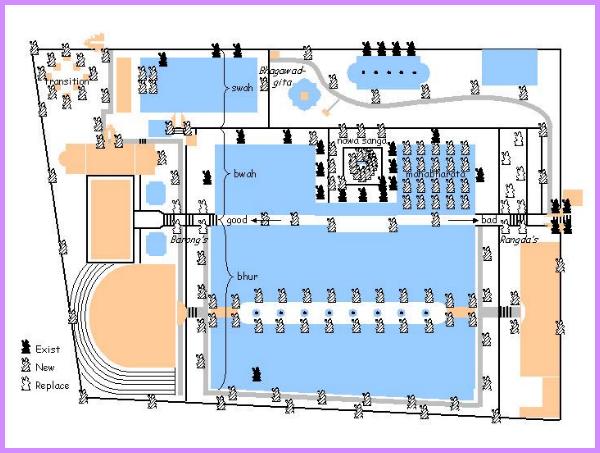
The sculptures of
Tirtagangga represent the following Balinese Hinduism concepts:
This concept divides the
cosmos into Bhur, Bwah and Swah. Swah is the upper world
of Gods, Bwah is the middle world of men and Bhur is the lower
world of demons. Similarly, sculptures of the divine world, such as the many
Hindu Gods (each represents an aspect of the only God Sang Hyang Widhi Wasa)
will be placed in the higher northern part of the gardens. The middle part will
be mainly occupied by sculptures of men and other objects of daily life.
Sculptures of demons, leyaks and other lower world creatures will
decorate the lower southern part of the gardens.
For everyone who wants to know more about Triloka, Mr. Thomas Moog has done a comprehensive study in the German language
by explaining the representation of this concept in Tirtagangga. Surf at www.moogbooks.com, or click directly on
the chapters below.



The transition
between these worlds is expressed by the 8 sculptures at the meditation centre
in the north-west corner of the garden.
Arising from the water of
the middle-east pond, the struggle of men between Gods and demons is symbolised
by 20 sculptures of Mahabharata figures.
The tension between Gods
and demons, between good and bad, is also represented by the sculptures of Barong
and Rangda at each end of the middle footpath.
Along the whole footpath
around the gardens sculptures will be placed to emphasise the differences
between these worlds. Lamps may be combined with these sculptures to light the
path according to the lightingplan.
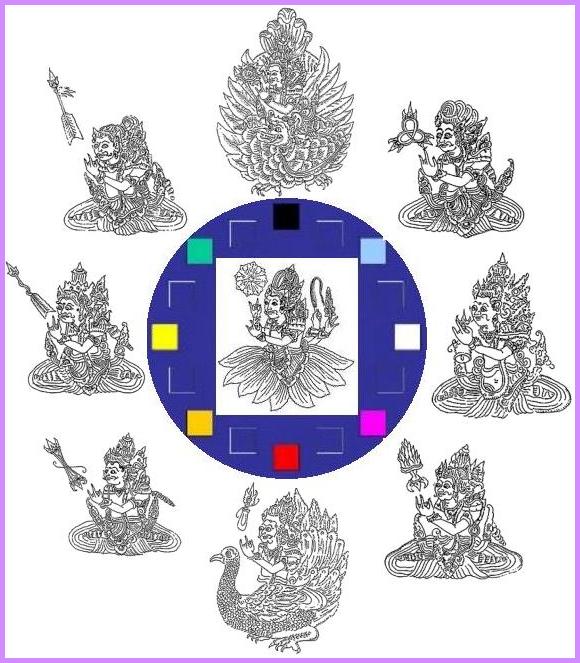
Eight sculptures around
the fountain tower in the middle of the gardens represent Nawa Sanga or Sanga
Mandala concept of cosmological orientation, a manifestation of the never
ending quest for order and harmony. Nawa Sanga delineates eight cardinal
directions around the centre point ofSiwa, often represented as a
phallus like the fountain tower it self. As shown below, the directions are
dominated by mountain-sea axis and sunrise-sunset axis, symbolised by specific
colours and deities according to Balinese mythology.
|
Direction |
Colour |
Deity |
|
Centre (puseh) |
Multi colour |
Siwa |
|
North (kaja) |
Black |
Wisnu |
|
Northeast (kaja-kangin) |
Blue |
Sambu |
|
East (kangin) |
White |
Iswara |
|
Southeast (kelod-kangin) |
Violet |
Mahasora |
|
South (kelod) |
Red |
Brahma |
|
South west (kelod-kauh) |
|
Rudra |
|
West (kauh) |
Yellow |
Mahadewa |
|
Northwest (kaja-kauh) |
Green |
Sangkara |
The physical
transformation of Nawa Sanga as one of the principles of Balinese architectural
design can be best exemplified in the spatial arrangement of a typical Balinese
housing compound. The traditional house is divided into nine areas, whereby the
Sanggah Kemulan or Pamerajan as the most sacred is located in
north(kaja)-mountain direction, aling-aling or the entrance gate,
as a dirtiest and the most public, is located in south(kelod) -sea
direction; and bale-bale or the working and sleeping places occupy the
centre area surrounding Natah or Natar.
In Bali, the most sacred
area is always placed in the direction of the holy mountain (
Below are the names of the
Pandawa and Kurawa figures, which arise from the water of the
middle-east pond to symbolise the struggle of men between Gods and demons.
|
Kunti |
Gatotkaca |
Krisna |
Abimanyu |
Srikandi |
|
X |
X |
X |
X |
X |
|
Nakula |
Bima |
Yudistira |
Arjuna |
Sudewa |
|
X |
X |
X |
X |
X |
|
|
|
[] |
|
|
|
X |
X |
X |
X |
X |
|
Citrayuda |
Dursasana |
Duryudana |
Citrawangsa |
Citragada |
|
X |
X |
X |
X |
X |
|
Bisma |
Karna |
Sangkuni |
Dorna |
Widura |
A path way between the statues
allows visitors to walk on the water, crossing the middle-east pond while
observing the Pandawa and Kurawa figures.
To
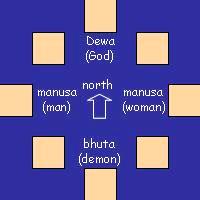
depict the endless transition of men between good (deity) and bad (demon),
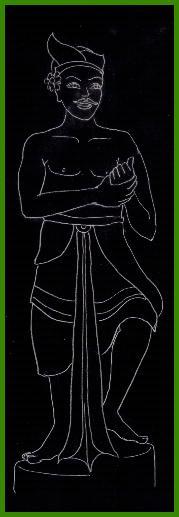
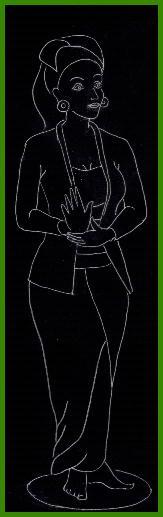
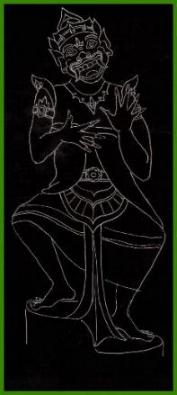
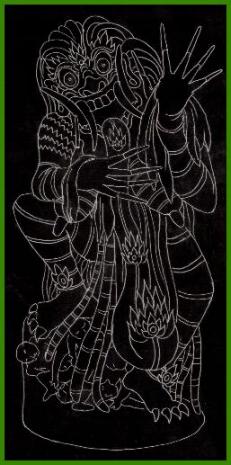
eight lifelike sculptures have been erected in a circle at the meditation area, the
most magical part at the north-west corner of the garden. Clockwise: man-deity,
deity, deity-woman, woman, woman-demon, demon, demon-man, man, and back to
man-deity.
In Bali Hinduism-Buddhism, the endeavour of life is to follow the path (Dharma) to reach Moksha (Nirvana), the ultimate
freedom, even from good, bad, life and other illusions like freedom it self. As
Dharma can not be forced, men is
subject to a never-ending struggle in the depicted circle (Samsara), unless Moksha
is reached.
|
|
|
|
|
|
|
|
|
|
|
|
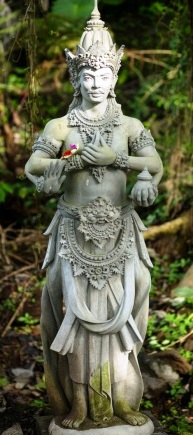
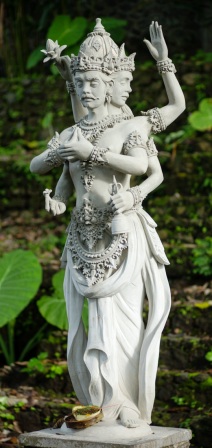
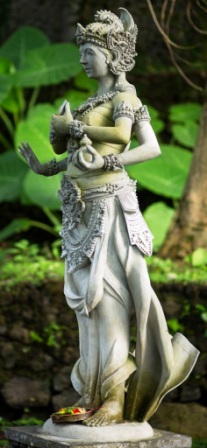
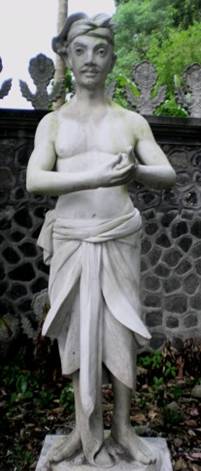
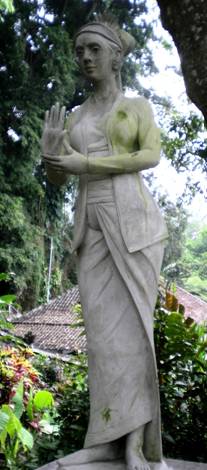
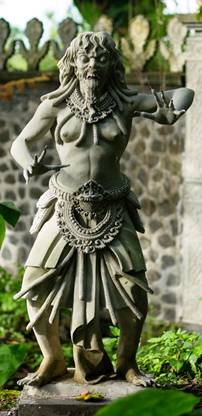
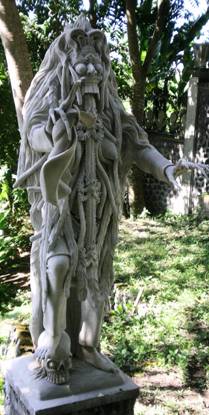
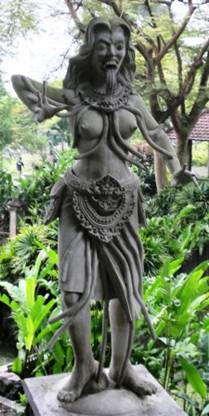
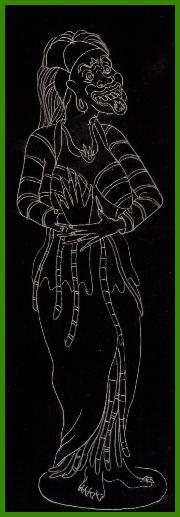
The above sculptures were based on my drawings below.
|
|
|
|
|
|
|
|
|
|
|
|
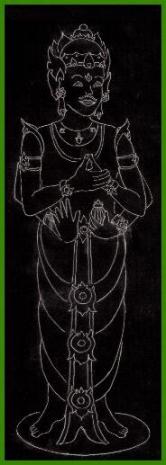
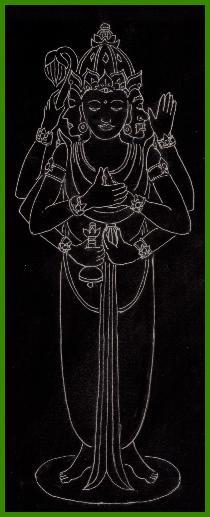
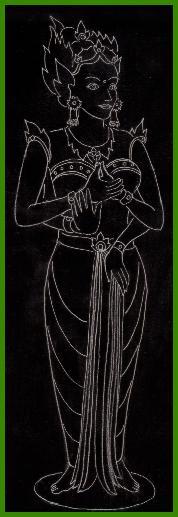
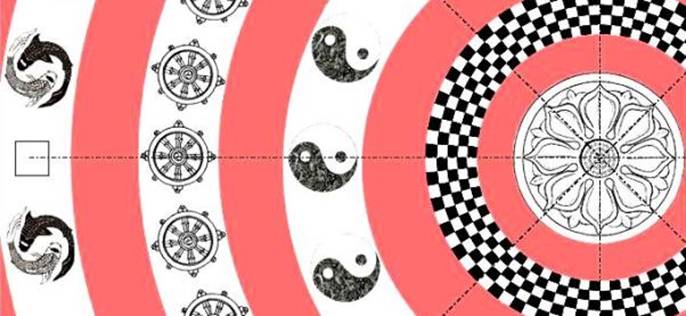
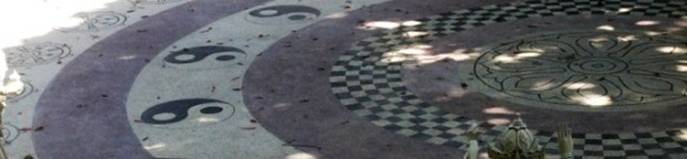
Between
the eight lifelike sculptures that depict the endless transition of men between good (deity) and
bad (demon), meditative ornaments have been laid on the floor of the meditation area.
|
|
From centre to outermost circle: - Padma (lotus), symbol of beauty and purity, encourages meditation free from
attachment and desire, just like the lotus it self is unstained while rising
from unclean, muddy water. -
Rwabhineda (Rwa = two, Bhineda = different),
Balinese black-white poleng decoration
on banners, statues, trees etc, expressing dualism, the presence of opponent
energies in all what exist. - Yin-Yang,
equivalent to Rwabhineda, basic
principle of Traditional Chinese Medicine, T'ai chi, Qigong, I Ching etc,
telling us that there is for example no darkness (Yin) without lightness
(Yang), that there is always light within dark, and vice versa. - Chakra (wheel), has many meaning such
as Vhisnu's weapon, circle of life, Shiva's wheel, energy nodes in the subtle body
etc, refers to the eastern circular logic that opponents are equal, in
contrast with the western Aristotelian linear logic that A can not be equal
to non-A. Like a wheel, opponents like day-night, happiness-sadness,
cause-effect (Kharma-Pala),
right-wrong, creation-preservation-expiration (Trimurti), life-death (reincarnation) etc. pursue each other for
ever in circles seeking for balance and harmony when they are desired as
real, instead of as manifestations of the only, simultaneously full and
empty, not by dualism distorted reality (Hinduism: Brahman, Buddhism: Sunyata,
Adibuddha,Taoism: Tao, Dao, Zen: Mu etc.) - Yin-Yang in the shape of fishes, to
honour the richness and beauty of those manifestations, represented by the
magnificent inhabitants of the ponds of Tirtagangga. |